

Last Updated: November 24, 2026
Quick Summary
Equine joint health supplements can support cartilage maintenance, synovial fluid quality and everyday comfort in horses, but they cannot reverse established arthritis or replace veterinary treatment. Expect four to eight weeks before meaningful change, with the full effect judged around twelve weeks. Match each label's milligrams per daily serving to published dose ranges before buying.
- Glucosamine has moderate, mixed evidence and remains a reasonable first-line inclusion for joint formulas.
- Oral hyaluronic acid is supportive only; injected HA has the clearest evidence base.
- Check glucosamine falls within the 6,000-10,000 mg per day range on the label.
- Calculate cost per daily serving rather than cost per tub when comparing products.
- Stop the supplement and talk to your vet if weekly mobility scores show no change by week twelve.
Table of Contents
- What Equine Joint Health Supplements Can and Cannot Do
- Equine Joint Supplement Ingredients That Have Evidence Behind Them
- Reading Labels: Matching Ingredient Levels to Recommended Doses
- How Long Do Horse Joint Supplements Take to Work?
- Choosing a Joint Supplement for Horses: A Practical Checklist
- Safety, Interactions and Competition Rules
- When Supplements Are Not Enough: Working With Your Vet
- Tracking Mobility and Comfort Over the First 12 Weeks
- Frequently Asked Questions
What Equine Joint Health Supplements Can and Cannot Do
Equine joint health supplements can support cartilage maintenance, synovial fluid quality and everyday comfort in horses, but they cannot reverse established arthritis or replace veterinary treatment.
Joints are built for low-friction movement. Cartilage cushions the ends of bones, synovial fluid lubricates the space between them, and soft tissue, tendons and ligaments, holds the whole structure steady. Wear accumulates with age, workload and conformation.
What they cannot do matters just as much. No oral supplement rebuilds cartilage that has already worn away, and none substitutes for diagnosis.
- Can do: support cartilage and joint fluid nutrition, help maintain comfort and mobility in older or working horses
- Cannot do: reverse structural damage, mask lameness, replace veterinary care
- Realistic expectation: gradual improvement over weeks to months, not days
Keep that distinction in mind. It shapes every decision below.
Equine Joint Supplement Ingredients That Have Evidence Behind Them
The core equine joint supplement ingredients fall into three groups: cartilage building blocks (glucosamine and chondroitin), joint fluid support (hyaluronic acid), and comfort support (MSM and omega-3 fatty acids). Evidence quality varies widely between them, so grade each ingredient rather than trusting the front of the tub. The grades below reflect how consistent the published horse research is, not how heavily a product markets the ingredient.
Glucosamine, moderate, mixed evidence. The longest research history in horses, but results across studies are inconsistent and responses vary between individuals.
Chondroitin sulfate, limited, often studied in combination. Fewer standalone horse trials than glucosamine, and most commercial research uses glucosamine-chondroitin combinations, so the independent effect is hard to isolate.
Hyaluronic acid, strong when injected, uncertain when oral. Intra-articular injection has the clearest evidence base of any joint intervention.
MSM, limited but plausible. Small horse studies suggest comfort benefits at higher doses, but the evidence base is modest and study sizes are small. Generally regarded as comfort-supporting rather than structure-rebuilding.
Omega-3 fatty acids (EPA and DHA), moderate for general comfort, not for cartilage. Evidence supports a role in modulating inflammatory pathways, but not in rebuilding cartilage. Marine sources typically deliver higher EPA and DHA per gram than flaxseed, which is mostly ALA and converts poorly in the horse.
What the grades mean in practice. An ingredient with moderate evidence is not a guarantee of response in your horse, and an ingredient with limited evidence is not worthless. For a closer look at how formulas are put together, see our guide to veterinary formulated supplements for horses.
Glucosamine for Horses: Cartilage Support and Dose
Glucosamine for horses is an amino sugar used as a building block in cartilage matrix. Published research commonly cites dose ranges for a full-size horse, though product labels vary and not every horse responds.
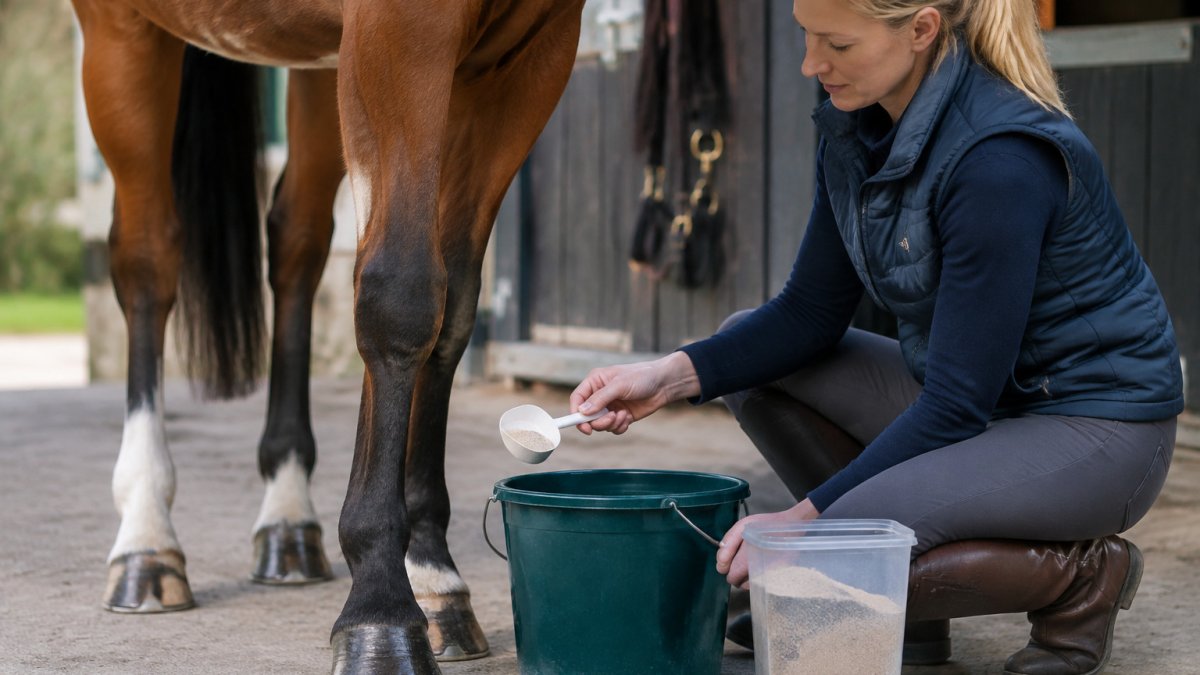
Two practical points. First, check the label states glucosamine in elemental or salt form and the milligrams per daily serving, not per scoop. Second, start at the label rate and hold it for at least eight weeks before judging. Splitting the dose across two feeds is common practice and may improve acceptance in fussy horses.
Chondroitin, Hyaluronic Acid, MSM and Omega-3s
Chondroitin sulfate pairs with glucosamine and is usually dosed in the low thousands of milligrams per day. Hyaluronic acid targets synovial fluid and low-friction movement; oral forms vary widely in molecular weight, which affects how much is absorbed.
Ingredient synergy matters more than any single number. A formula with modest glucosamine but well-balanced chondroitin, MSM and omega-3s often outperforms a high-dose single ingredient, because the pathways being supported are different. Watch out: a tub that lists several ingredients but gives no milligrams per daily serving is not a formula you can grade at all.
Reading Labels: Matching Ingredient Levels to Recommended Doses
Match the label's active ingredients to a stated recommended dose per day, not per scoop, and compare that figure against published ranges. This is where most buying mistakes happen.
A label that lists "glucosamine complex 5,000 mg" per scoop tells you little until you know how many scoops make a daily serving and how much is actual glucosamine. Do the arithmetic before you buy:
| What to check | Good sign | Warning sign |
|---|---|---|
| Dose basis | mg per daily serving stated | mg per scoop only |
| Ingredient form | Named form, e.g. glucosamine sulfate | "Complex" or "blend" with no breakdown |
| Glucosamine level | Within 6,000-10,000 mg/day range | Far below range with no explanation |
| Other actives | Chondroitin, MSM, HA, omega-3s listed | Single ingredient at inflated dose |
| Serving size | Clear scoop weight in grams | Vague "one scoop" |
Watch out: a tub that lists impressive ingredient names but never states milligrams per daily serving is usually hiding a low dose behind a long label.
How Long Do Horse Joint Supplements Take to Work?
How long do horse joint supplements take to work? Most owners should expect four to eight weeks before seeing meaningful change, with the full effect often judged around the twelve-week mark.
Several things influence supplement response: the horse's age, the stage of joint wear, workload, body condition and whether the dose is actually being eaten. A horse that sifts supplement out of its feed is not being supplemented at all.
- Weeks 1-2: no visible change expected
- Weeks 3-6: subtle shifts in stiffness after rest
- Weeks 8-12: clearer changes in movement and willingness to work
- Beyond 12 weeks: reassess honestly, adjust or stop
If your horse is older or in regular work, our guidance on supporting an older horse after exercise pairs well with a supplement program while you wait for results.
Choosing a Joint Supplement for Horses: A Practical Checklist
Choosing a joint supplement for horses comes down to dose transparency, ingredient form, palatability and consistency of supply. Run every product through the same checklist before you commit.
- Daily serving states milligrams for each active ingredient
- Glucosamine falls within a recognised daily range
- At least two supporting ingredients present, e.g. chondroitin and MSM
- Formula is palatable enough that the horse cleans it up
- Batch and quality information is available on request
- Supply is reliable so you can hold the same dose for twelve weeks
- Cost per daily serving calculated, not cost per tub
That last point catches people out. A larger tub at a higher shelf price can still be cheaper per day. Divide the tub price by the number of daily servings it contains.
At Farrell's and PrimeVet, our formulas are developed by veterinary scientists and nutritionists, including Professor David Evans BVSc PhD, and produced in small batches with a focus on quality over volume. If you have buying questions about dosing or subscriptions, our frequently asked questions cover the common ones directly.
Safety, Interactions and Competition Rules
Safety starts with correct dosing and honest disclosure.
Adverse effects to watch for are mostly mild and digestive: loose manure, reduced appetite, or a horse that becomes suspicious of its feed.
Interactions deserve attention. Horses on veterinary medication, particularly for lameness or metabolic conditions, should have any supplement cleared with the treating vet first.
Contamination is the risk owners underestimate. Supplements are not regulated in the same way as registered veterinary medicines.
Competition rules are the other half of safety. Rules on permitted substances vary by discipline and by the body that governs your sport, and they change.
When Supplements Are Not Enough: Working With Your Vet
Supplements are not enough when there is heat, swelling, marked lameness, a sudden change in gait or a horse that is off its feed. Those signs need veterinary diagnosis, imaging and a treatment plan, not another supplement.
A vet can identify whether the problem sits in the joint, the soft tissue or elsewhere, and can advise on injectable joint therapy, farriery, workload changes and pain management. Bring your supplement labels to the appointment.
If you are unsure which of our products suits your horse or want guidance on what we offer veterinary partners, our contact page is the place to start.
Tracking Mobility and Comfort Over the First 12 Weeks
Track mobility and comfort with a simple weekly score, recorded at the same time and under the same conditions each week. Memory is unreliable; a written record turns a vague feeling into a decision.

Score four things each week on a simple scale:
- Stride: does the horse track up freely in walk and trot?
- Stiffness: how many steps before it loosens after rest?
- Comfort: willingness to pick up feet, roll, lie down
- Work tolerance: attitude under saddle or in the yard
Review the scores at week twelve. If nothing has shifted, stop the supplement and talk to your vet rather than adding a second product on top. If scores improved, hold the dose and keep recording.
Joint wear is a long game, and guesswork costs you months. Work through the label checklist, hold the dose for twelve weeks and record what you see.
Frequently Asked Questions
What ingredients should I look for in a horse joint supplement?
Look for named active ingredients with stated amounts per daily serving: glucosamine, chondroitin sulfate, hyaluronic acid, MSM and omega-3 fatty acids (EPA and DHA). Glucosamine is the most studied for cartilage support, with effective doses commonly cited in the 6,000 to 10,000 mg per day range. Check that the label gives milligrams per serving rather than a proprietary blend total, because a long ingredient list means little if the levels are too low to matter.
Do equine joint supplements actually work?
The evidence varies by ingredient. Glucosamine and chondroitin have the most research behind them for cartilage support and joint comfort, though results are modest and inconsistent across studies. MSM and omega-3s have smaller but supportive evidence for comfort. Supplements support joint health; they do not reverse arthritis or repair damaged cartilage. If your horse is lame or worsening, a veterinary examination should come first so you know what you are managing.
Is glucosamine or collagen better for horses?
Glucosamine has decades of research behind it for cartilage support and joint mobility, which is why it anchors most equine joint formulas. Collagen provides amino acids used in connective tissue, but there is far less horse-specific evidence for it. If you are choosing one, glucosamine at a meaningful daily dose is the better-supported starting point. Some formulas combine both, which is reasonable, but check that the glucosamine level is still adequate rather than token.
How long does it take for a horse joint supplement to work?
Most owners should allow 4 to 8 weeks before judging a joint supplement, and some horses need up to 12 weeks for a clear change in movement and comfort. Cartilage and synovial fluid changes happen slowly. Keep a simple record of how your horse moves, warms up and recovers after work so you can compare honestly. If there is no difference after 12 weeks at a proper dose, the supplement is probably not the right fit.
Can horses take joint supplements every day?
Yes, joint supplements are designed for daily feeding, and consistency matters more than occasional large doses. Follow the label's recommended daily serving and split it across feeds if your horse is fussy. Introduce a new supplement gradually over about a week to reduce the chance of refusal or loose manure. If your horse is on medication or has a diagnosed condition, confirm the daily plan with your vet before starting.
Should I consult a veterinarian before giving my horse a joint supplement?
Speak to your vet first if your horse is lame, has swelling or heat in a joint, or is worsening. A supplement cannot substitute for diagnosis. For a healthy horse with age- or workload-related stiffness, a vet can still confirm there is no underlying issue and check for interactions with any medication. Bring the product label to the appointment so your vet can review the actual ingredient levels rather than a general description.



Leave a comment
All comments are moderated before being published.
This site is protected by hCaptcha and the hCaptcha Privacy Policy and Terms of Service apply.